Skip to content

Platform · BK EMS

The software that decides what every kWh does.

BK EMS monitors, optimises and controls the battery, solar PV, grid and consumption in real time. We develop and operate it ourselves: no third-party dependency.

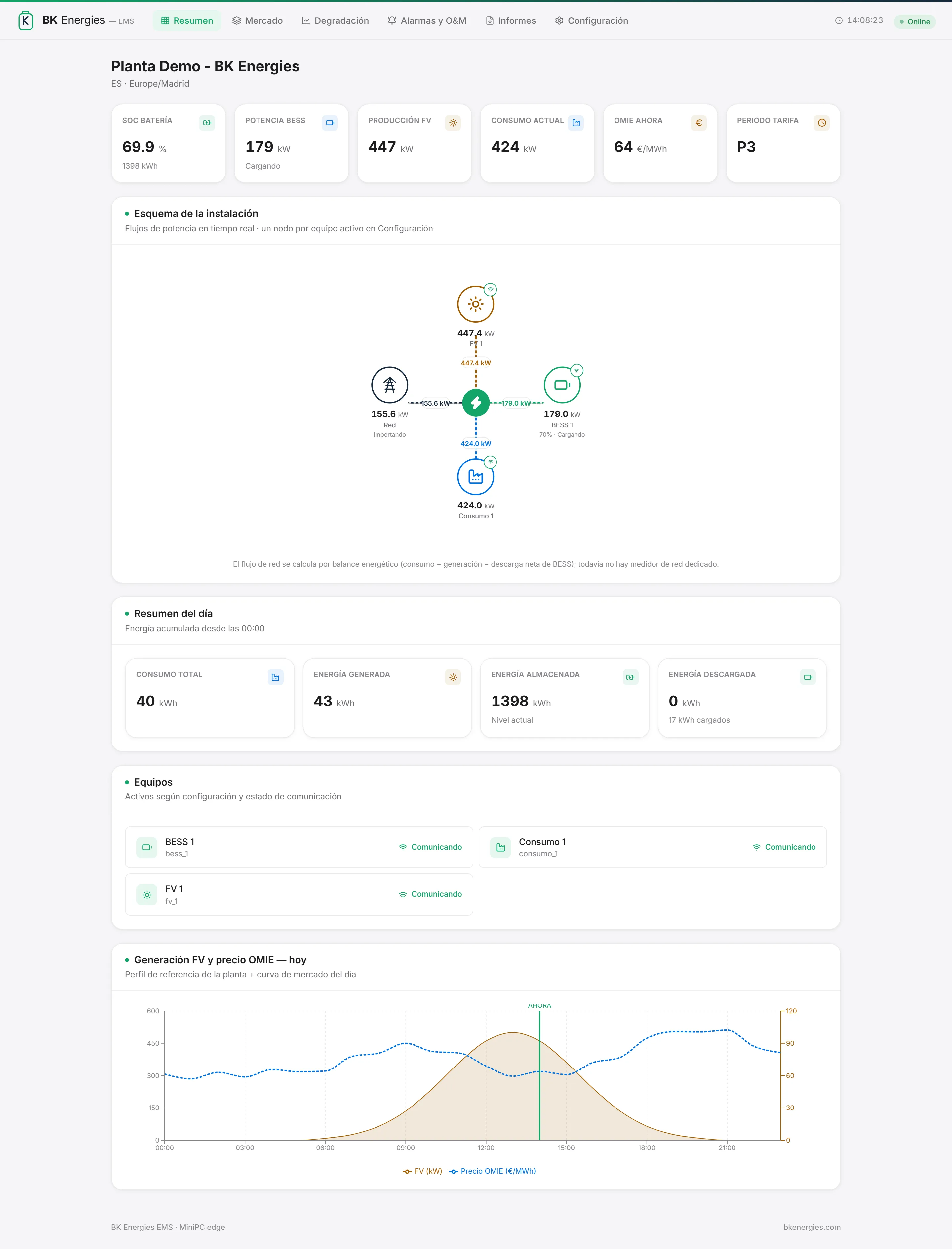
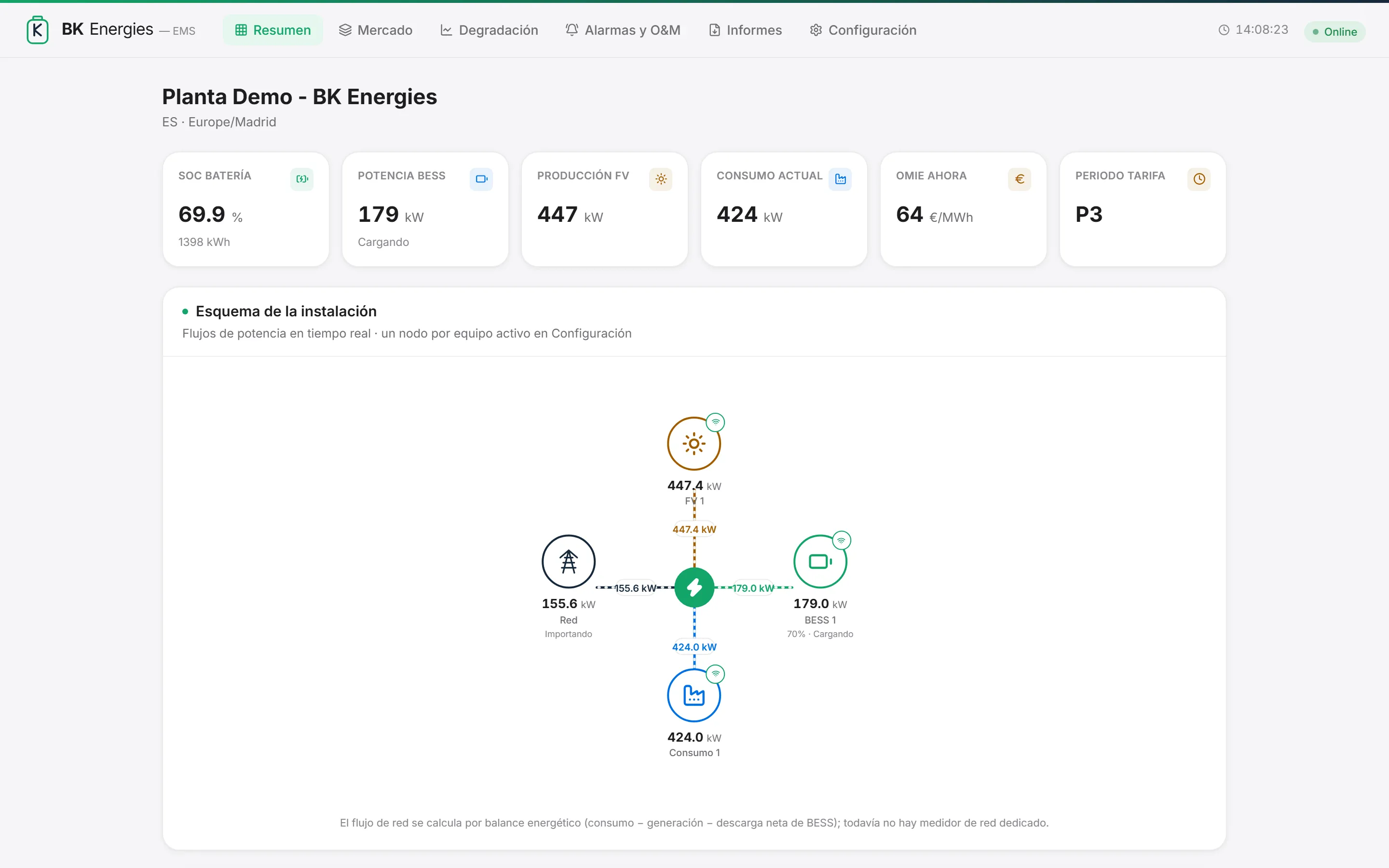
BK EMS Overview tab with state of charge, power, OMIE price and plant flow diagram

Architecture

One EMS, two levels.

The EMS Local runs the plant. The Operations EMS oversees all plants at once and decides based on the market. Both integrate BMS, inverters, meters and sensors.

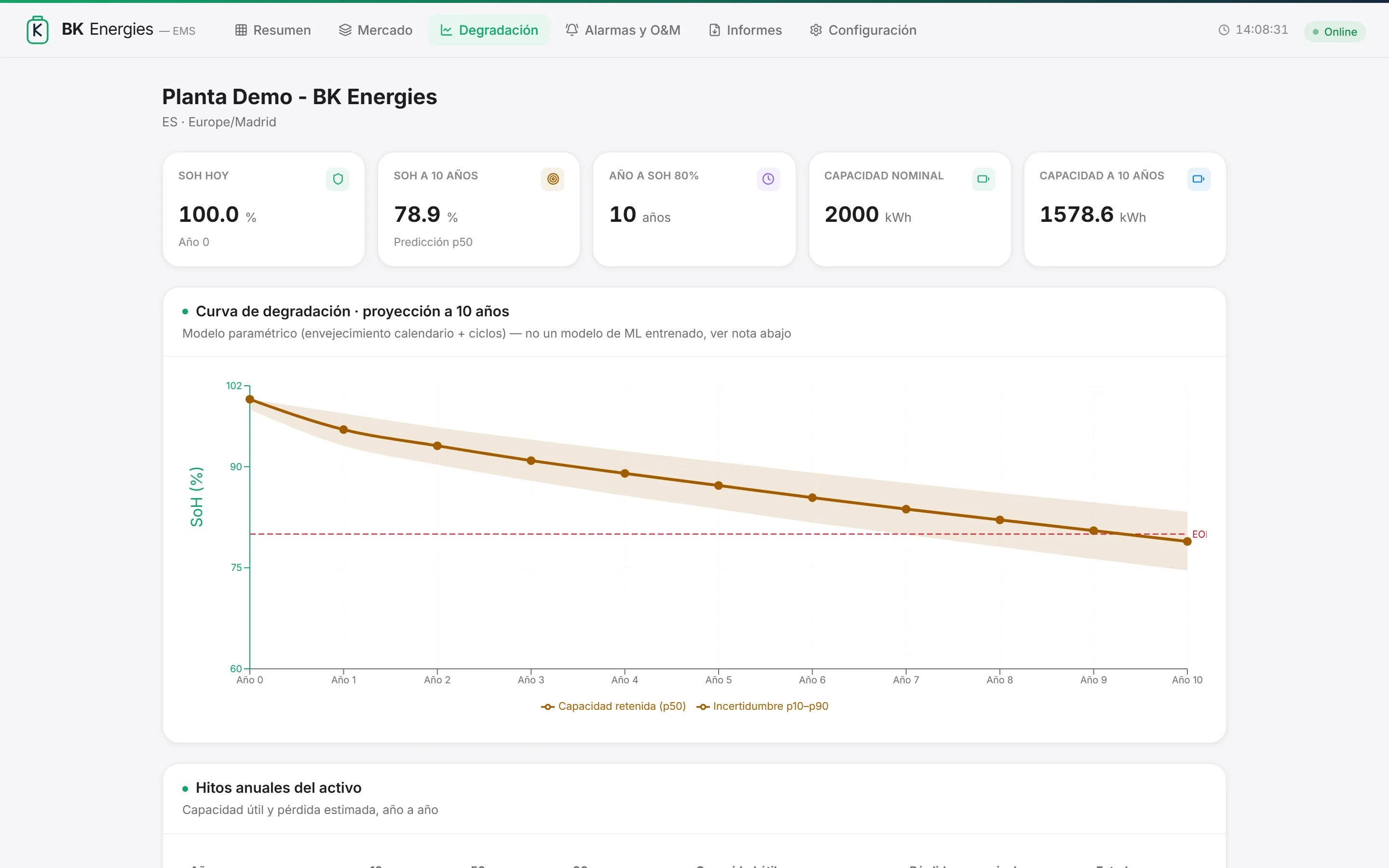
BK EMS Local: battery state of health and degradationOn site

EMS Local

Runs on site, next to the battery, with local control. Sees every device and every cell.

  • Overview and history
  • Electrical monitoring
  • Device- and cell-level supervision
  • Environmental, thermal and safety control
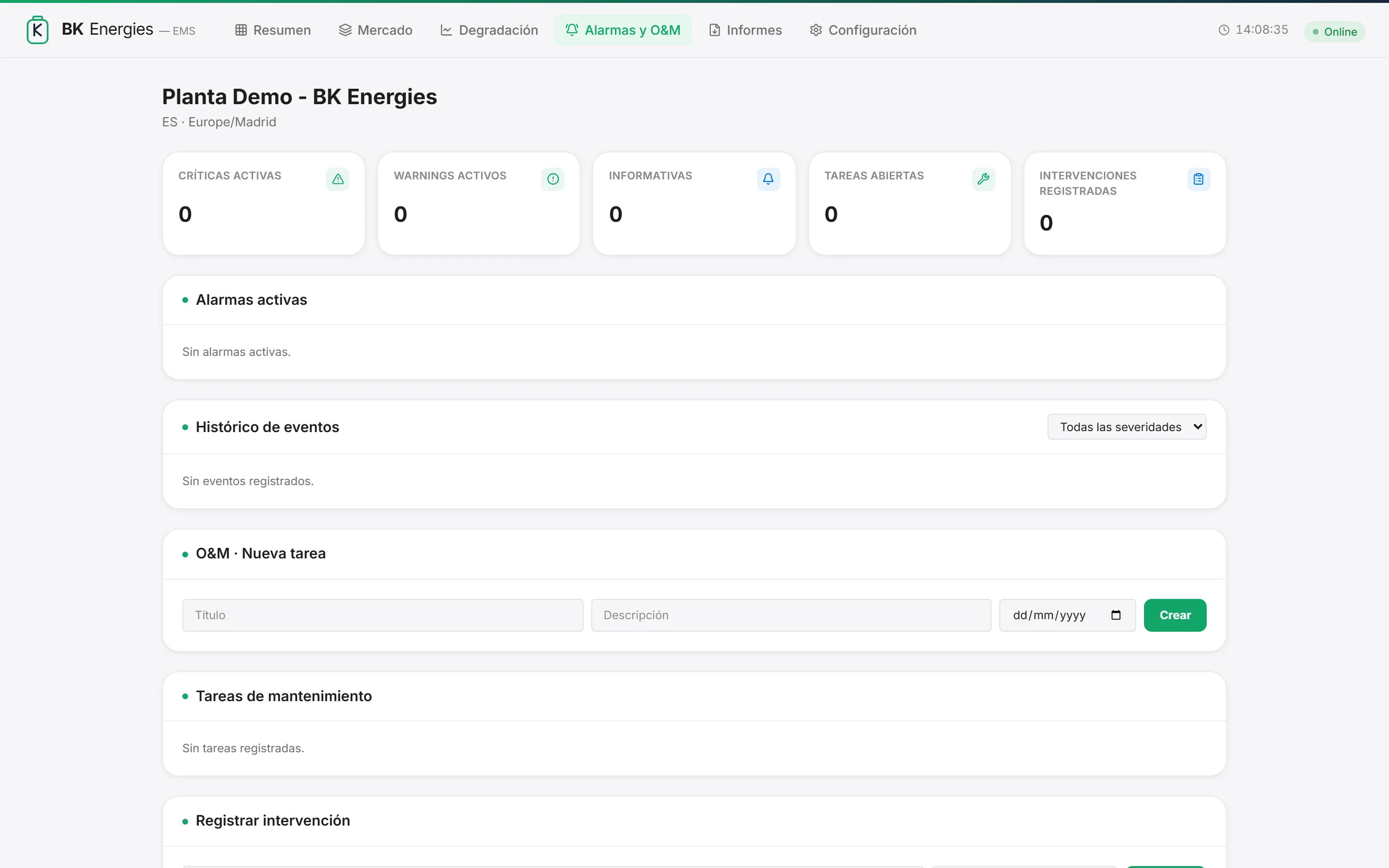
  • Alarms and data export
  • Operating strategies
BK EMS: full plant view with flows and daily energyCentralised

Operations EMS

From the control centre it manages several plants at once, schedules hour by hour and decides based on the market price.

  • AI-based hourly scheduling
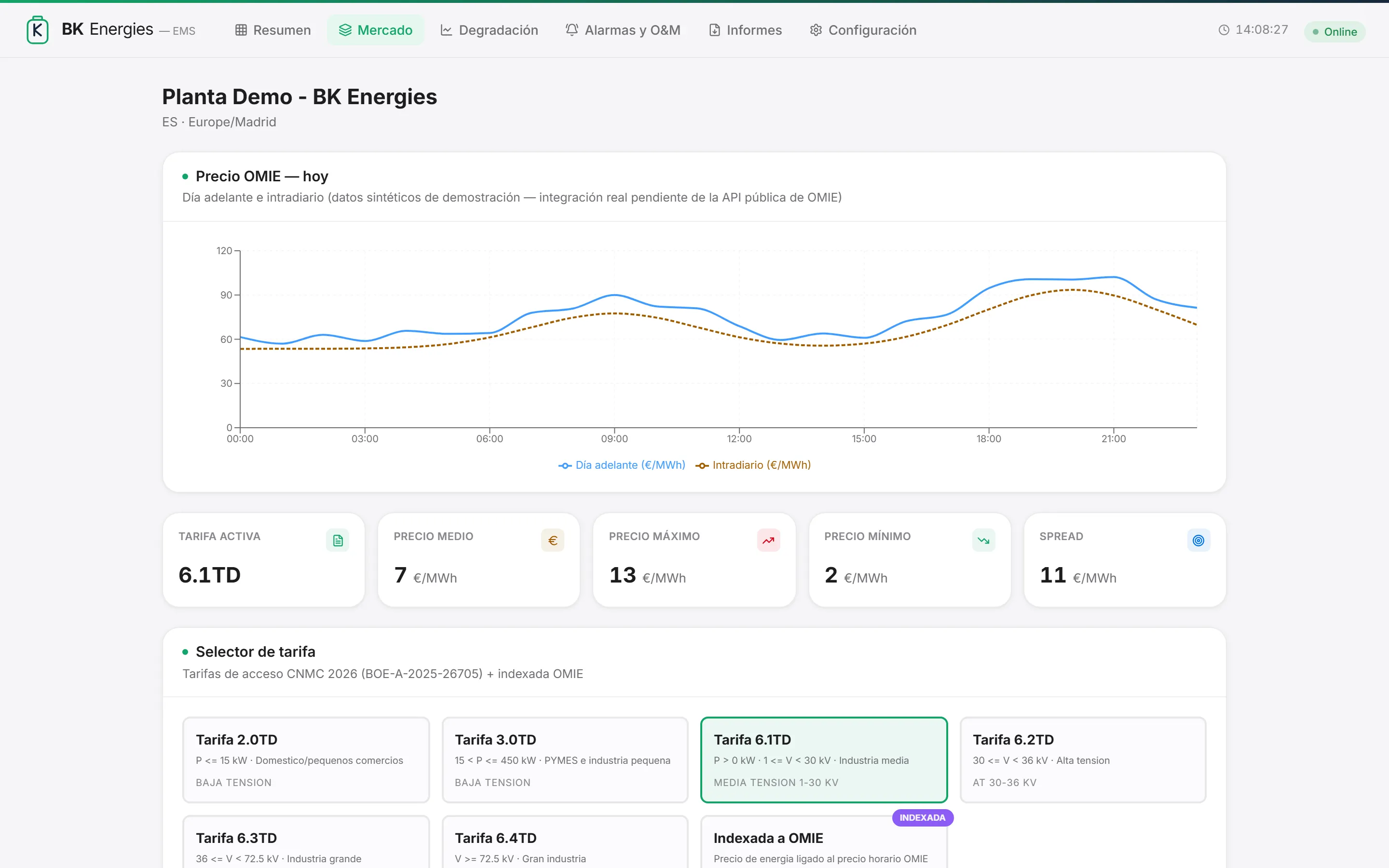
  • Market price analysis
  • Real-time flows, multi-site
  • Energy heat map
  • Charge and discharge power
  • Manual or automatic strategies and peak shaving

Local and remote control. Over-the-air (OTA) software updates, with no site visits.

This is what it looks like inside

Six tabs. The whole plant.

Click each module to see the real BK EMS screen and what it solves.

BK EMS Overview tab: SoC, BESS power, PV generation, consumption, OMIE price and tariff period indicators, and plant power flow diagram

01 · Overview

The plant at a glance

State of charge, battery power, PV generation, consumption, OMIE price and tariff period in real time. The diagram draws the flows between grid, PV, battery and load, with one node per active device.

  • SoC, power and daily energy
  • Live power flows
  • Communication status per device

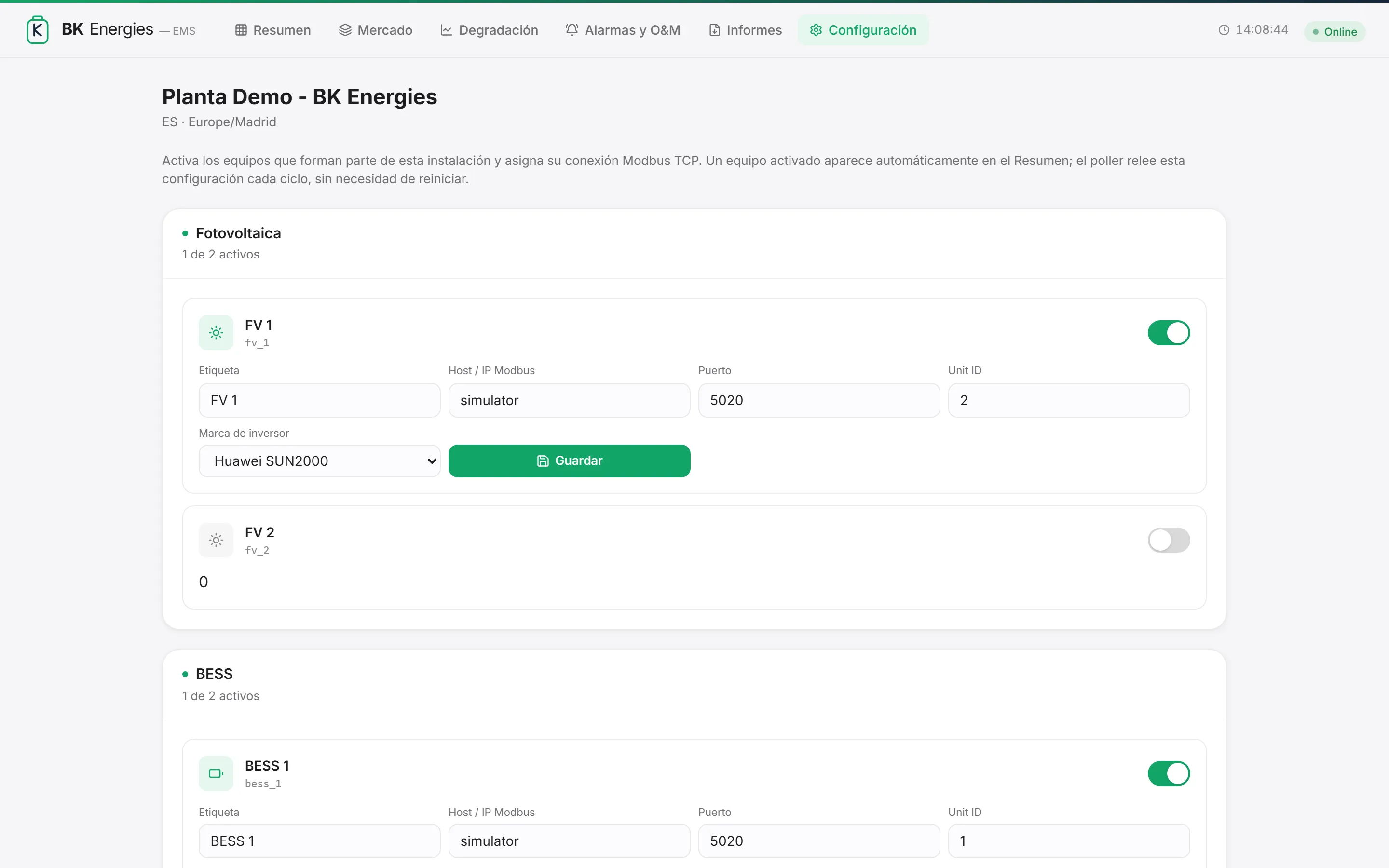
Real screenshots of BK EMS running on a demonstration plant with simulated data.

Capabilities

What the EMS does every minute.

Control algorithms, continuous monitoring and communication with BMS, inverters and auxiliaries. For industry, hybridisation and utility.

Forecast

Demand and generation with machine learning

Estimates the load curve and renewable generation for the coming hours to plan dispatch ahead of time.

Arbitrage

Charge cheap, discharge dear

Calculates the cost of energy in real time based on market price and tariff, and assigns each cycle to the most valuable hours.

Peak shaving

Power peak shaving

The battery supplies demand peaks so you never exceed contracted power or pay excess charges.

Grid

Operator setpoints and PPC

Receives and follows active and reactive power setpoints at the point of connection, with plant control (Power Plant Controller).

Contingencies

Grid balancing and stability

Detects frequency and voltage variations and responds to keep the installation stable and connected.

Diagnostics

Energy heat map

Colour-codes the energy behaviour of each device and each hour so that any anomaly stands out.

Operating modes

Automatic, with priorities and limits.

Each mode has its own priority and state-of-charge margins. The EMS switches between them without intervention.

  1. 01

    Self-consumption

    Stores the solar surplus and uses it when there is no sun.

  2. 02

    Backup

    Reserves energy to cover grid outages.

  3. 03

    Surplus export

    Exports to the grid in the best-paid hours.

  4. 04

    EV charging

    Powers chargers without upgrading the grid connection.

  5. 05

    SoC/DoD limits

    Priorities and charge margins per mode.

Input data

It decides with the real market, not a fixed schedule.

The EMS connects to the sources that drive the value of a kWh and recalculates the plan when they change.

OMIE day-ahead
Hourly day-ahead market price
OMIE intraday
Schedule adjustment close to real time
Balancing services
System operator balancing markets
AEMET
Weather forecast for PV generation
Access tariffs
P1–P6 periods and 2.0TD to 6.4TD grid access charges
OMIE · day-ahead market · 23 Sep 2026real data
050100150200250300CHARGEDISCHARGE00h06h12h18h23h
Charge
13:00–15:00
Discharge
20:00–22:00
Capturable spread
€232/MWh

Example with a 2 h battery and one cycle per day on the real day-ahead market price.

Range

EMS Core, Pro and Max.

The same platform in three tiers, depending on the number of assets and the type of grid connection.

Comparison of EMS Core, EMS Pro and EMS Max
FeatureCommercial and industrialEMS CoreMulti-assetEMS ProUtility-scaleEMS Max
Typical installationsFactories, warehouses and microgridsLarge industry, small and mid-sized PV, generators, hybrid systemsPV + BESS plants and grid-connected standalone energy storage
What it solvesSelf-consumption, peak shaving and backupCoordinate multiple sources and batteries at a single supply pointForecasting, market operation and compliance with system operator requirements
Works withPower Pro · CabinetsCabinets · Hybrid and STSPowerbolt
More informationView application View application View application

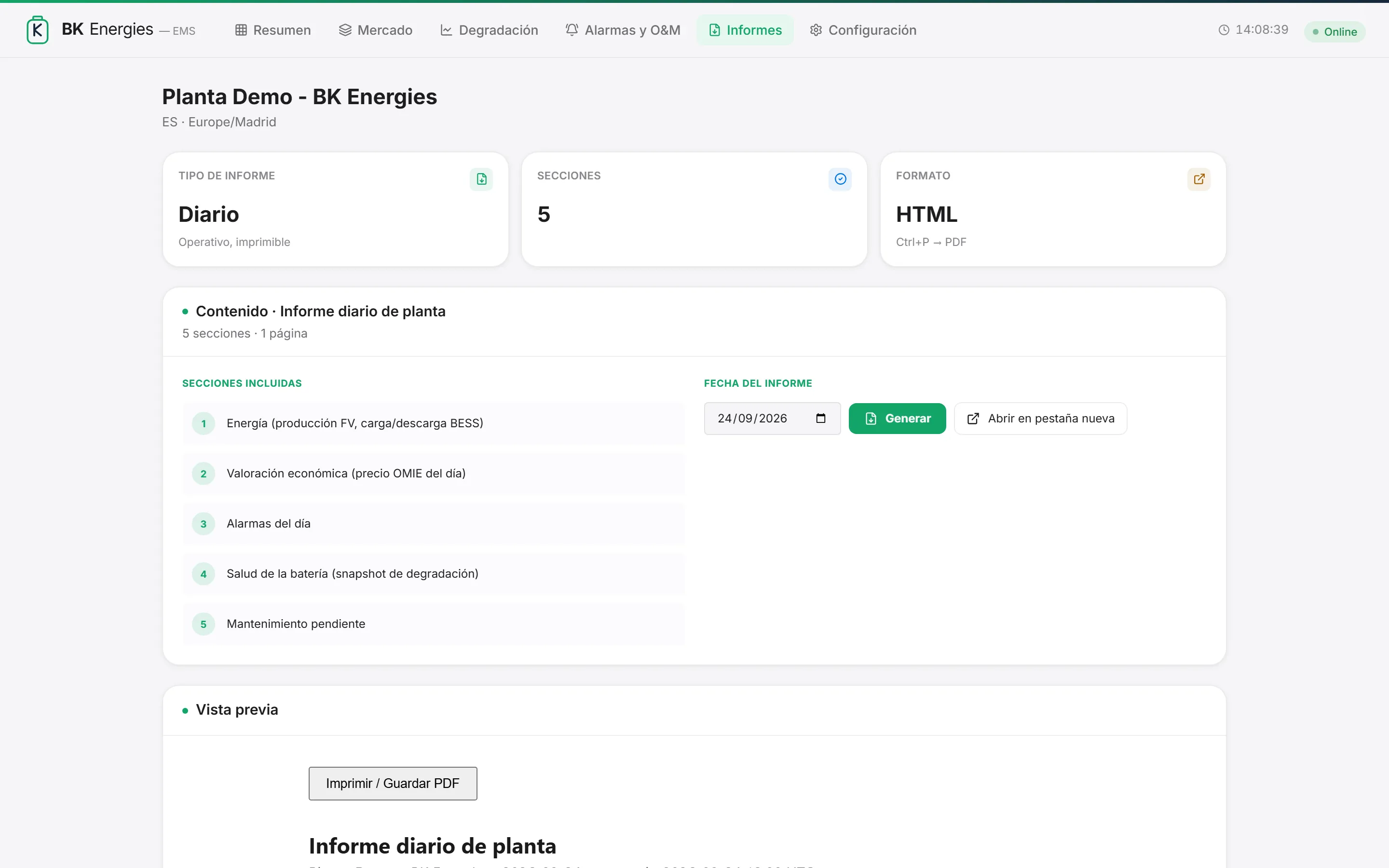
All tiers include web and mobile dashboards, history, alarms and reports in PDF and CSV. The exact tier is defined with our engineers for each project.

Integration

It speaks every device's language.

Native industrial protocols and an open API to connect SCADA, ERP, trading platforms and IoT devices.

  • IEC 61850
  • Modbus TCP
  • OPC-UA
  • Open API
  • IoT
  • OTA updates

Standards and grid codes

UNE-EN IEC 62933
Electrical energy storage systems
UNE-EN 50549-10
Requirements for grid connection of generators
REE grid codes
System operator technical requirements

Cybersecurity

A connected battery is a critical asset.

We treat the EMS as infrastructure: encrypted communications, a firewall and every user with just the permissions they need.

Encryption

Communications over TLS 1.2 / 1.3

Perimeter

Built-in firewall

Access

Role-based user management

Independence

In-house software: no reliance on third parties to operate

Want to see BK EMS with your plant's data?

We show you the EMS on a call and tell you which tier fits your installation, whether it is an industrial building, a PV plant or a grid-scale BESS.